Your Reliable High Quality Wholesale Custom Clothing Manufacturers

How to Choose the Right Fabric GSM for Your Clothing Line
I spoke with a startup founder last week who was frustrated with his latest batch of T-shirts. “The first run was perfect—soft but structured,” he explained. “This new batch feels flimsy, almost see-through. My supplier promised it was the ‘same cotton,’ but my customers are already complaining.” It’s a good example of why it’s important to choose fabric GSM carefully when manufacturing garments.
His problem wasn’t the cotton; it was the fabric weight. He had approved a design but had overlooked one of the most critical specifications in apparel manufacturing: the GSM.
That single metric—Grams per Square Meter—is the silent variable that determines whether a hoodie feels like a luxury item or a cheap promotional giveaway. It dictates if a T-shirt drapes elegantly or clings uncomfortably. In 2026, as brands fight for customer loyalty in a saturated market, moving beyond subjective descriptions and mastering technical specifications like GSM is no longer optional. It’s fundamental to building a reputable and consistent clothing line.
Many brands, especially those sourcing from different regions, get lost in translation between imperial and metric units. A supplier in the United States might talk in ounces per square yard (oz/yd²), while a factory in Asia will almost exclusively use GSM. Understanding how to navigate these metrics is crucial for clear communication and getting the product you envisioned.
Let’s walk through why choose fabric GSM weight is a cornerstone of garment quality and how to use it to your advantage.
1. Why Fabric Weight Matters More Than Ever
Choosing a fabric is not just about color and composition. The weight, or density, of the material is a technical choice that has commercial consequences. Leading private label clothing manufacturers use standardized GSM testing to ensure every batch meets the brand’s specific quality benchmarks.
•Product Quality & Durability: Heavier fabrics generally withstand more wear and tear, leading to a longer garment lifespan and higher customer satisfaction.
•Drape and Structure: The weight determines how a fabric falls on the body. A lightweight fabric offers a fluid, flowing drape, while a heavyweight fabric provides a stiff, structured silhouette.
•Seasonal Appropriateness: A low GSM is ideal for summer collections, offering breathability. A high GSM provides insulation, making it suitable for winter apparel.
•Perceived Value: Customers often associate heavier fabrics with higher quality. The substantial hand-feel of a heavyweight hoodie, for instance, can justify a premium price point.
•Printability: Smoother, denser fabrics (often in the mid-to-heavy range) provide a better canvas for high-quality printing techniques like screen printing or DTG.
In other words, the GSM you choose is a direct message to your customer about the quality and intended use of your product.
2. What the Right Fabric GSM Brings to the Table
In 2026, a data-driven approach to fabric selection separates successful brands from the rest. By specifying the exact GSM, you create a repeatable standard that ensures consistency across every production run, regardless of the factory. This technical clarity is the foundation of a scalable apparel business.
This is why many established brands provide their manufacturers with a detailed tech pack that explicitly states the required GSM for each component of a garment. It removes ambiguity and protects the brand from the exact issue our founder faced.
Below are the key technical considerations for mastering fabric weight.
A. GSM vs. Ounces (oz): The Metric vs. Imperial Divide
Understanding the difference between these two units is the first step. While both measure fabric density, they are not interchangeable.
•GSM (Grams per Square Meter): The weight of a 1-meter by 1-meter square of fabric in grams. This is the global standard used in most parts of the world.
•oz/yd² (Ounces per Square Yard): The weight of a 1-yard by 1-yard square of fabric in ounces. This is primarily used in the United States.
To avoid confusion, use this simple conversion: 1 oz/yd² = 33.906 GSM. For example, a 5.3 oz T-shirt is approximately 180 GSM. Always clarify with your supplier which unit they are using and standardize on GSM for all your internal documents.
B. How to Measure Fabric GSM
While you should rely on your supplier’s specifications, you can verify the GSM yourself with a simple process. You will need a digital gram scale and a fabric swatch of a known size.
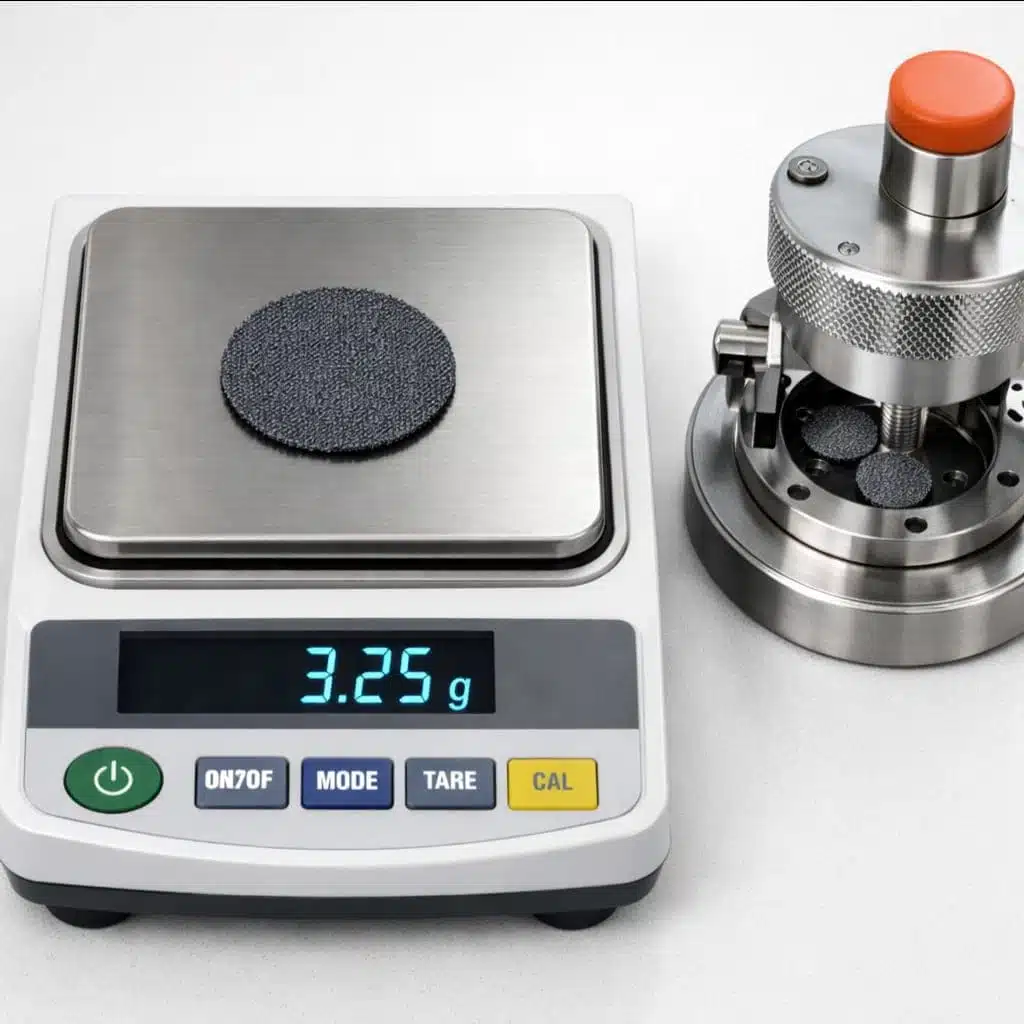
1.Cut a precise square of fabric, for example, 10cm x 10cm (0.01 m²).
2.Place the swatch on the digital scale and record its weight in grams.
3.Calculate the GSM using the formula: GSM = (Weight of Swatch in grams / Area of Swatch in m²) .
For our 10x10cm swatch, you would multiply the weight by 100 to get the final GSM. This simple quality control check can save you from a disastrous production run.
C. Heavyweight vs. Lightweight Fabrics: A Comparative Look
The choice between heavyweight and lightweight fabric depends entirely on your product’s purpose.
| Feature | Lightweight Fabric (e.g., < 160 GSM) | Heavyweight Fabric (e.g., > 300 GSM) |
| Feel | Soft, airy, breathable | Sturdy, substantial, warm |
| Drape | Fluid, clings to the body | Stiff, structured, holds its shape |
| Best For | Summer T-shirts, activewear, base layers | Winter hoodies, premium sweatshirts, jackets |
| Durability | Less durable, prone to stretching | Highly durable, resistant to wear |
| Opacity | Can be semi-sheer | Fully opaque |
D. What is a good GSM for T-shirts and Hoodies?
This is one of the most common questions for new brands. While there is no single “best” weight, there are industry-standard ranges that serve as an excellent starting point.
•For T-shirts:
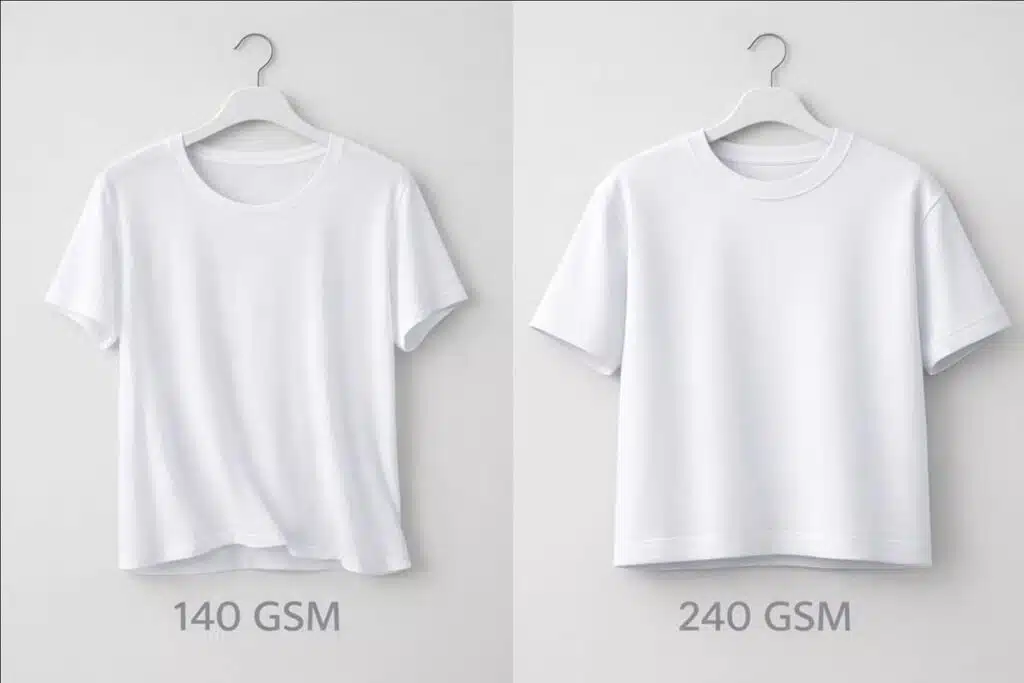
•120-160 GSM (Lightweight): Common for fast-fashion or budget-friendly shirts. Good for hot climates but may lack durability.
•160-200 GSM (Midweight): The sweet spot for most premium T-shirt brands. A 180 GSM shirt offers a great balance of structure, softness, and durability. It feels substantial without being too heavy.
•200+ GSM (Heavyweight): Used for high-end, oversized, or streetwear-style T-shirts. Provides a boxy, structured fit.
•For Hoodies & Sweatshirts:
•250-300 GSM (Midweight): A standard, all-season hoodie. Comfortable and versatile but may not feel sufficiently “premium.”
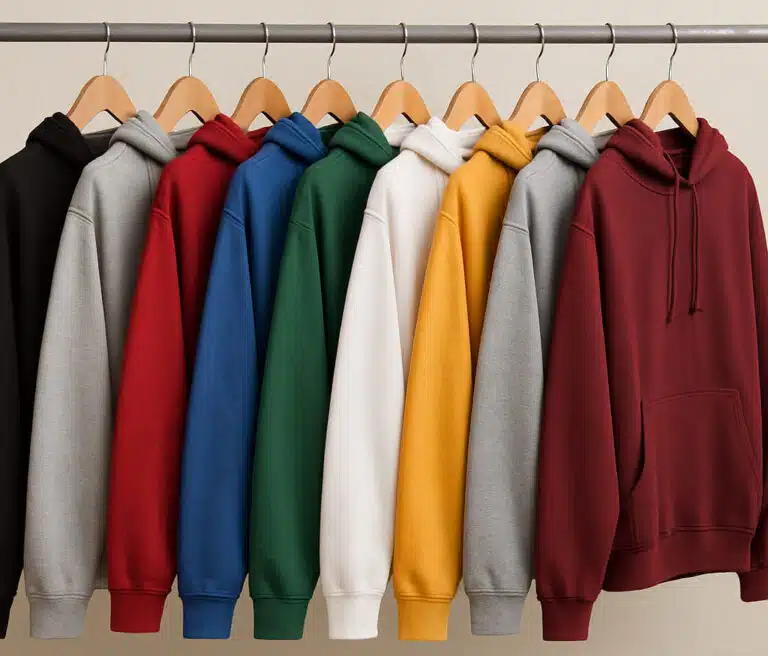
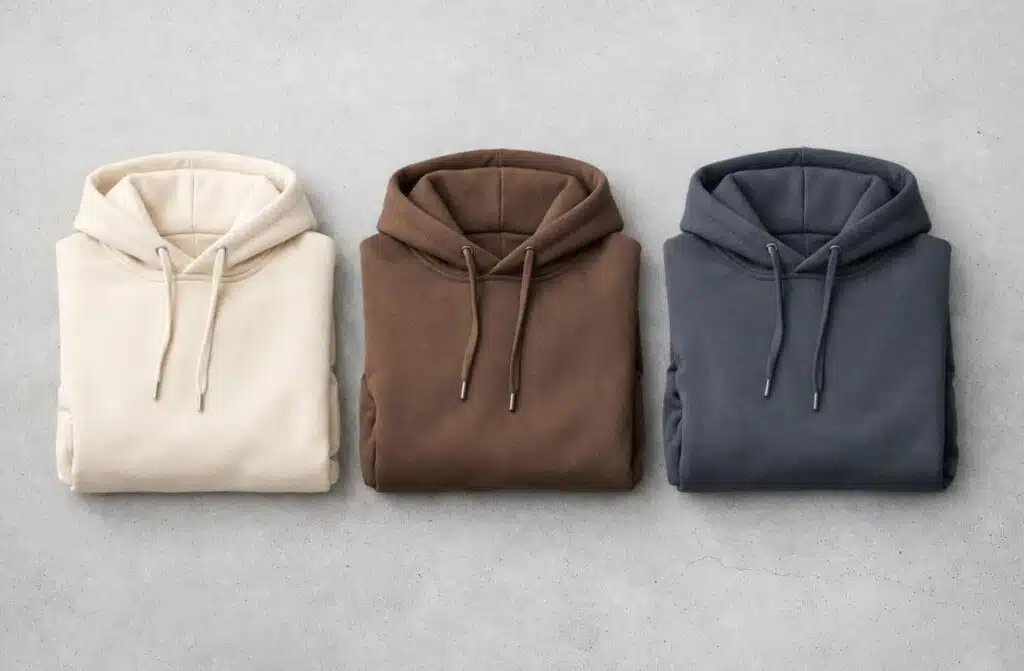
•300-400 GSM (Heavyweight): This is the ideal range for high-quality, winter-weight hoodies. A 320 GSM or 350 GSM fleece or French terry provides excellent warmth, a sturdy structure, and a luxurious hand-feel that customers associate with quality. When working with a specialized custom hoodies manufacturer, specifying a GSM between 320 and 400 is essential for that premium, structured feel.
•400+ GSM (Ultra-Heavyweight): Reserved for luxury or specialty workwear brands. Extremely durable and warm, but can feel bulky.
The Most Important Insights To Act On
•Fabric weight is a feature, not just a spec. Market it. If you are using a 350 GSM fleece for your hoodies, say so in your product description. Educate your customers on why it matters.
•Consistency is key. Once you find a GSM that works for a specific product, lock it in. Do not allow suppliers to deviate, even by 10-20 GSM, as it will change the entire character of the garment.
•Weight impacts shipping costs. Heavier garments cost more to ship. Factor this into your COGS (Cost of Goods Sold) and pricing strategy, especially for international sales.
Practical advice ecommerce founders can use this week
•Audit your current product line: If you don’t know the GSM of your best-selling T-shirt, ask your supplier immediately. Create a simple spreadsheet listing every product and its corresponding fabric weight.
•Reverse-engineer your competitors: Order a product from a brand you admire. Feel the fabric. If you can, perform a GSM test on it to understand the standard they are setting.
•Update your tech packs: Add a mandatory “Fabric Weight (GSM)” field to your tech pack template. Make it a non-negotiable part of your communication with any manufacturer.
•Create a physical swatch library: Start collecting and labeling fabric swatches with their GSM, composition, and supplier. This physical library will become an invaluable tool for future product development.
Next steps to keep improving
If you are developing a new product, define its target feel and function first, then select a GSM range that aligns with that goal. Use this article as a guide to create a “Fabric Weight Standard” document for your brand. This document should outline the approved GSM for each core product category (T-shirts, hoodies, etc.). This simple standard operating procedure (SOP) will ensure that as your brand scales, your quality remains consistent, protecting the customer trust you’ve worked so hard to build.
Summary
Understanding GSM is a fundamental skill for building a successful clothing brand in 2026. It moves your production process from guesswork to a science, ensuring consistency, quality, and clear communication with your manufacturing partners. By mastering fabric weight, you control the garment’s final feel, durability, and perceived value.
Start by auditing your existing products, updating your tech packs with mandatory GSM specifications, and educating your customers on why a heavier, well-chosen fabric is a mark of true quality. This technical focus is the foundation for building a brand that stands the test of time.